NEW RELEASES · 2026

The lives we
leave unlived.

Two novels from Michael Silberman, exploring the lives we imagine and the choices we have to live with.

Discover the books

CATASTERISM & I Didn’t Do Anything to Lose Except Try My Hardest

THE MAS BOOKSHELF

Explore the novels.

2026 / TWO RELEASES
01CATASTERISM book cover

A NOVEL

Catasterism

In Palm Springs, explanations come easily. Consequences are another matter.

A former lawyer makes his living selling drugs to people who prefer not to think of themselves as customers. When a man he knows stops breathing at a hotel party, the explanations he has relied on begin to fail.

Elsewhere in the desert, a struggling art gallery becomes Catasterism, a gathering place for things people cannot say anywhere else. He helps give it a name while keeping his own life carefully out of reach.

Purchase links coming soon.

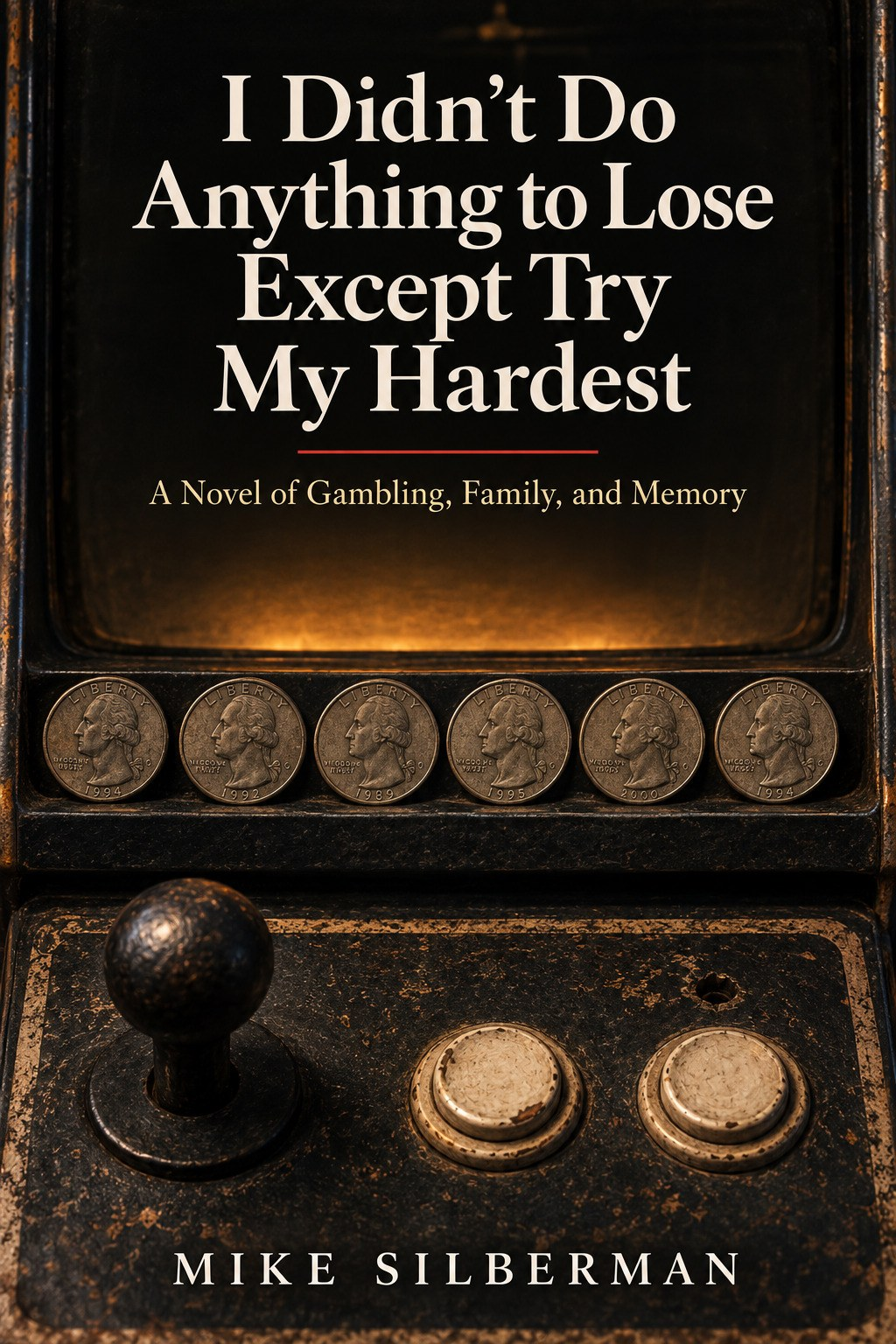
02I Didn’t Do Anything to Lose Except Try My Hardest book cover

A NOVEL OF GAMBLING, FAMILY, AND MEMORY

I Didn’t Do Anything to Lose Except Try My Hardest

At nine, Danny’s family vacation means quarters in the arcade, arguments with his brother, and a grandmother who can turn a hotel complaint into a lifelong acquaintance. Years later, after gambling has cost him his money and his home, he returns to those memories with a recorder and questions his family does not always want to answer.

His grandmother has questions of her own. Moving between a child’s view of the casino and the adult lives surrounding it, the novel follows a man trying to account for his choices while the people he remembers insist on correcting the record.

Purchase links coming soon.

BEHIND THE BOOKS

MAS Publishing Co.

The home of Catasterism and I Didn’t Do Anything to Lose Except Try My Hardest.

MAS Publishing Co. artwork featuring its gold lettering, desert landscapes, casino imagery, and books
MAS PUBLISHING CO. / EXCERPT

Catasterism

From Chapter One

The man on the bathroom floor was wearing one Gucci loafer.

The other one stood upright beside the toilet, polished black leather with the heel crushed flat from a year of being stepped into without hands, pointed at the door as though it had let itself in and was waiting to be told where to go next.

I noticed the shoe first.

Six people were shouting at once. Somebody had left the shower running and nobody had thought to turn it off, so the room was filling with steam behind a naked man I had never met in my life, who kept asking me, with real hope, whether I happened to be a doctor.

“No.”

“You—you know what he took?”

“I know some of it.”

“What does that—what does that mean?”

“It means move.”

He moved. His name turned out to be Trevor, which I learned the way you learn anything at a party like that one: by hearing it screamed at thirty-second intervals from four directions by people who had no intention of doing the thing themselves. Trevor, get a towel. Trevor, call downstairs. Trevor, where’s his phone. Trevor, for God’s sake put some pants on. Trevor did none of it. He stood at the sink with both hands pressed flat against his own cheeks while the steam rolled along the ceiling and drifted out into the suite, and he held that position long enough that I stopped expecting anything from him and started working around him like he was furniture that happened to be crying.

Noticing the shoe first bothered me later, and it goes on bothering me, because I have had a long time to work out what kind of man takes inventory of the footwear in a room where somebody has stopped breathing, and every answer I have come up with is a version of the same answer: I had spent years training myself to look at the one part of a scene that could not put me in prison.

The room belonged to a man named Julian, who sold commercial real estate and who had spent the better part of a year telling me, in the particular voice men use for a future they have already decided to believe in, that he was about to make partner. His company’s website still listed him as an associate. I had checked it once, alone in a parking lot, for no reason I could defend then or defend now, had felt bad about checking, and had gone on knowing what I found anyway.

He was thirty-eight. He had a closet full of Saint Laurent. He owed me fourteen hundred dollars. He was the one on the floor.

“Julian.” Nothing. I slapped the tile beside his face, hard, twice. “Julian.” His eyelids came up maybe a quarter of the way and went back down.

Three small silver stars were stuck to his forehead—somebody had been decorating people earlier in the night, in a mood that had since ended, and the party had gone on long enough past that mood that glitter had quietly turned into medical information.

A woman in a white dress crouched beside me and put one hand down on the floor for balance. “Is he dying?”

“I don’t know.”

“You sell this stuff.” That came from somewhere behind me, out of the crowd, and nobody answered it and nobody turned to see who’d said it, which is the one real advantage of a room with enough people in it: an accusation can go up into the air and circle for a while and never come back down on anybody, and everyone can agree afterward that it was never really said at all.

The woman in white had mascara under one eye and none under the other. She had been crying long enough to ruin half her face without noticing.

“What do we do?”

“Call 911.”

End of excerpt. © 2026 Michael Silberman. All rights reserved.
MAS PUBLISHING CO. / EXCERPT

I Didn’t Do Anything to Lose Except Try My Hardest

The Form

The intake office had carpet the color of oatmeal and a clipboard with a pen attached by a chain nobody would ever test.

I had lost everything a person can lose on paper — the money, the credit, the apartment the money had been pretending to maintain — and I had done it holding two degrees. I went to a good university and then got my CPA license, and I say that flatly, because the credentials changed nothing. The disease does not check credentials at the door; it takes the door. I could reconcile a ledger and I could not show up. Anywhere. For anything. A man who cannot show up cannot be employed, housed, or argued with, and by the end I was none of the three, and the street does not validate parking.

The woman behind the desk read my answers upside down while I wrote them, professionally, and did not hurry me. The form wanted the ordinary catalogue. Name. Date of birth. Emergency contact — I gave my mother, and then sat looking at the words emergency and contact for a while, because the form had put them together like it knew us. Education: I wrote college. Then, because the line was long and some part of me still wanted partial credit somewhere, I added my CPA license.

She read it upside down and did not look impressed, which was correct, and I have thought about her professionalism with gratitude ever since. In that office a CPA license was a fact about a man the way a watch is a fact about a wrist. The form did not ask what I had done with my education. The form asked where I had slept last night.

I wrote the truth. It was the first form in years I had filled out without arranging it.

Underneath every page that follows there is one question, and it is not mine. It is the one my grandmother put to me before I had answered anything else, with the camera already running and her coffee going cold on purpose.

When did it start.

End of excerpt. © 2026 Michael Silberman. All rights reserved.